SAP GRC to SAP IAG Migration Guide for GCC Enterprises
Governance Readiness Assessment
The transition to SAP IAG is a pivotal step in your organization's digital transformation. Don't let compliance gaps or configuration errors derail your project. Kgenex offers a 2-day Migration Feasibility Study: Assessment of your current GRC footprint. "IAG Bridge" architecture design. ROI and TCO analysis for your specific landscape.
Book Your Migration Discovery Session with Kgenex ExpertsEnterprises are shifting from legacy on-premise SAP GRC Access Control to the cloud-native SAP Cloud Identity Access Governance (IAG) to support S/4HANA transformations, reduce Total Cost of Ownership (TCO), and enable continuous compliance. This migration is a strategic shift from Static Compliance (point-in-time) to Dynamic Governance (real-time, cloud-integrated). This guide outlines the roadmap, risks, and GCC-specific considerations for a successful transition.
Before initiating the migration, it is critical to align your team on the core capabilities and transformative benefits of the target environment. If you need a refresher on how the system functions post-migration, review our [Comprehensive SAP IAG Enterprise Guide]
Why Organizations Are Migrating
- S/4HANA Transformation: Legacy GRC is often too rigid for the dynamic, API-driven nature of S/4HANA Cloud environments.
- Hybrid Landscape Complexity: GRC struggles with modern SaaS (Ariba, SuccessFactors, Concur). IAG is built for this heterogeneity.
- TCO Reduction: Moving away from managing underlying databases and infrastructure reduces IT overhead significantly.
- Audit Fatigue: Manual, point-in-time certification processes are being replaced by continuous, automated risk analysis, meeting higher regulatory standards (e.g., SAMA/NCA).
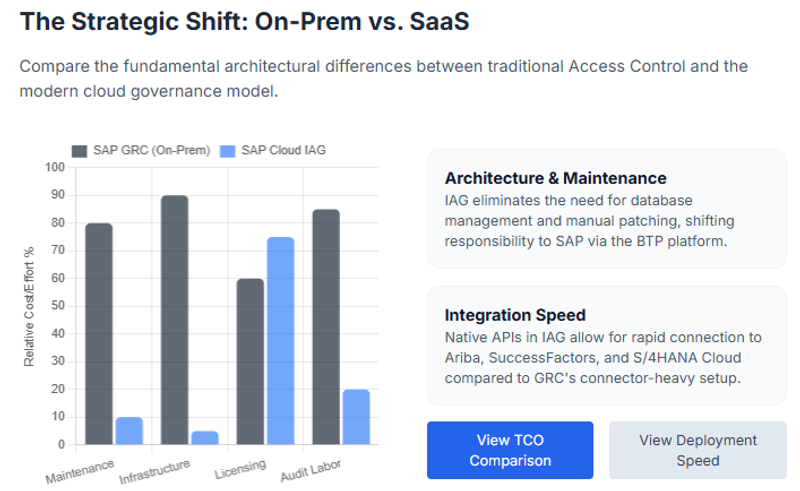
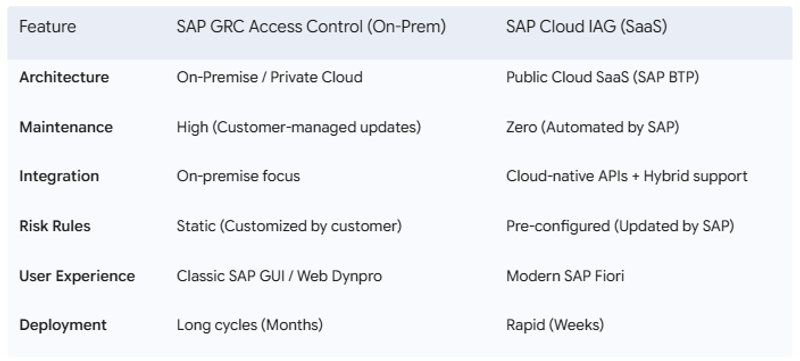
SAP GRC vs. SAP IAG: The Strategic Comparison
Migration Roadmap: The Kgenex 4-Phase Approach
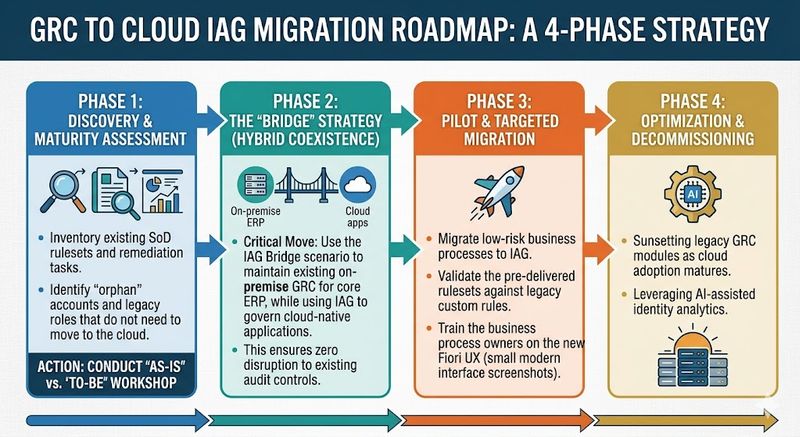
Phase 1: Discovery & Maturity Assessment
- Inventory existing SoD rulesets and remediation tasks.
- Identify "orphan" accounts and legacy roles that do not need to move to the cloud.
- Action: Conduct an "As-Is" versus "To-Be" workshop.
Phase 2: The "Bridge" Strategy (Hybrid Coexistence)
- Critical Move: Most enterprises do not perform a "Big Bang" migration. Use the IAG Bridge scenario to maintain existing on-premise GRC for core ERP, while using IAG to govern cloud-native applications.
- This ensures zero disruption to existing audit controls.
Phase 3: Pilot & Targeted Migration
- Migrate low-risk business processes to IAG.
- Validate the pre-delivered rulesets against legacy custom rules.
- Train the business process owners on the new Fiori UX.
Phase 4: Optimization & Decommissioning
- Sunsetting legacy GRC modules as cloud adoption matures.
- Leveraging AI-assisted identity analytics.
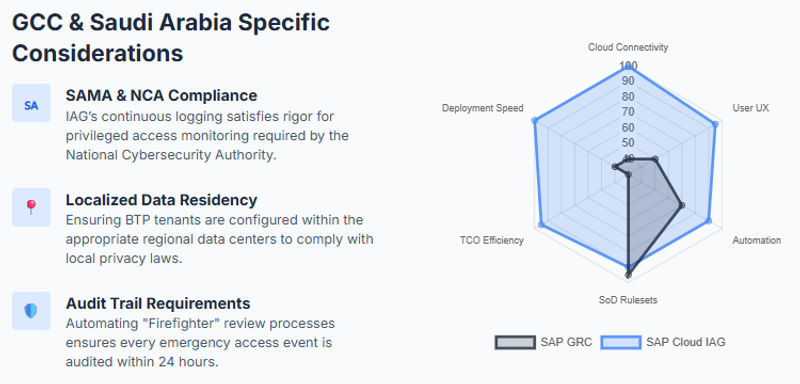
GCC & Saudi Arabia Specific Considerations
For enterprises operating under SAMA (Saudi Central Bank) or NCA (National Cybersecurity Authority) mandates:
- Localized Data Residency: Ensure the BTP tenant is configured within the appropriate region.
- Audit Trail Requirements: IAG’s continuous logging capability is a powerful tool to satisfy SAMA’s rigorous requirements for privileged access monitoring.
- Localization of Roles: Use SAP IAG to enforce strictly localized business roles that comply with regional data privacy laws.
Risks & Mitigation Strategies
- Risk: Data Quality. Moving "bad" roles from GRC to IAG creates "clean" bad roles in the cloud.
- Mitigation: Perform a role optimization/clean-up exercise before migration.
- Risk: Change Management. The Fiori UX is a significant shift for SAP Security teams accustomed to GUI.
- Mitigation: Early involvement of business stakeholders in User Access Review (UAR) simulation.
Migration Readiness Checklist
- [ ] Are existing custom SoD rules documented and rationalized?
- [ ] Is an SAP BTP subaccount provisioned in the correct region?
- [ ] Have Business Process Owners (BPOs) been identified for approval workflows?
- [ ] Has the integration with the existing Identity Provider (IdP) been mapped?
- [ ] Is the "IAG Bridge" architecture defined for hybrid systems?
Industry-Specific Scenarios
1. Banking (SAMA Compliance)
- Scenario: Managing high-security privileged access.
- Value: SAP IAG automates the "Firefighter" review process, ensuring that every emergency access event in S/4HANA is logged and audited within 24 hours to meet SAMA requirements.
2. Oil & Gas (Large Contractor Base)
- Scenario: High turnover of contractor identities across Joint Ventures.
- Value: Automated lifecycle management ensures that access is revoked instantly when a contractor’s status changes, preventing "ghost" access.
SAP Cloud IAG vs SAP GRC: Which Access Governance Solution Do You Need?
SAP IAG Governance Readiness Assessment: A Guide for GCC Enterprises
SAP IAG Implementation Roadmap: A Strategic Guide for GCC Enterprises
SAP IAG ROI & Business Case: A Strategic Guide for GCC Enterprises
SAP Official Documentation:
SAP Help Portal for Cloud Identity Access Governance.
Gartner/Forrester:
Industry reports on Identity Governance and Administration (IGA) trends.
National Cybersecurity Authority (NCA):
Saudi Arabia’s official guidelines on access control requirements.
Frequently Asked Questions
Can we keep our custom GRC rulesets in IAG?
Yes, but you shouldn't. IAG rulesets are maintained by SAP and updated automatically. We recommend migrating to the standard rules and using custom rules only for unique business requirements.
Is IAG suitable for on-premise SAP systems?
Yes, using the SAP Cloud Connector, IAG provides robust governance for on-premise SAP ECC or S/4HANA
How do we handle the "Legacy Role" problem?
This is the #1 migration bottleneck. Kgenex recommends a "Cleanup-before-Migration" phase to avoid carrying technical debt into the cloud.
Governance Readiness Assessment
The transition to SAP IAG is a pivotal step in your organization's digital transformation. Don't let compliance gaps or configuration errors derail your project. Kgenex offers a 2-day Migration Feasibility Study: Assessment of your current GRC footprint. "IAG Bridge" architecture design. ROI and TCO analysis for your specific landscape.
Book Your Migration Discovery Session with Kgenex ExpertsKgenex SAP Security & Identity Governance Practice
Reviewed by: SAP GRC, SAP IAG & Identity Governance Consultants at Kgenex