SAP Cloud IAG vs SAP GRC: Which Access Governance Solution Do You Need?
Ready to modernize your enterprise access governance?
Manual compliance processes are no longer sustainable in a cloud-first world. At Kgenex, our experts specialize in securing complex SAP landscapes and ensuring compliance with regional mandates across Saudi Arabia and the GCC. Contact our advisory team today to schedule an SAP IAG readiness assessment and discover how automated governance can accelerate your digital transformation.
Let's Go!Discover how SAP Cloud Identity Access Governance (IAG) automates compliance, manages SoD risks, and secures SAP S/4HANA. Read the enterprise guide from Kgenex.
Is Your Current Governance Model a Liability?
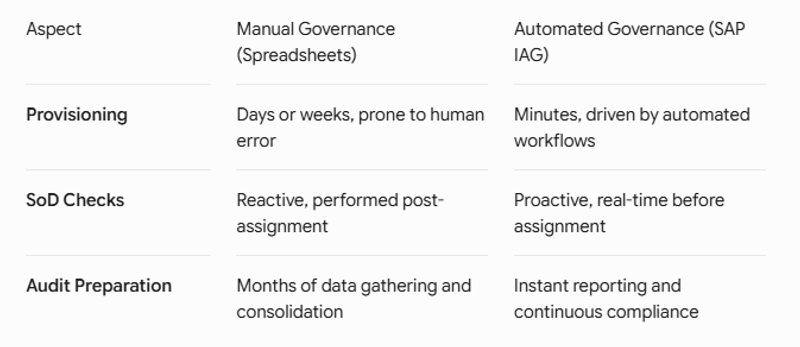
Manual governance isn't just an inefficiency; it’s a security liability. If your organization relies on spreadsheets for user access reviews, you are likely failing the NCA and SAMA requirements for "Continuous Monitoring." Every day you spend manually reconciling Segregation of Duties (SoD) conflicts or chasing email approvals is a day your internal controls are technically non-compliant. In the current regulatory climate, reactive governance is no longer enough—it is a risk to your operational license.
The Definitive Guide to SAP Cloud Identity Access Governance (IAG) for the Modern Enterprise
As organizations across Saudi Arabia and the GCC accelerate their digital transformations in alignment with Saudi Vision 2030, the complexity of managing digital identities and securing critical systems has grown exponentially. For enterprises migrating to SAP S/4HANA or adopting hybrid cloud architectures, legacy access control methods are no longer sufficient. Enter SAP Cloud Identity Access Governance (IAG).
This comprehensive guide explores how SAP IAG addresses modern governance challenges, how it compares to legacy and third-party solutions, and why it is critical for ensuring continuous compliance and operational efficiency.
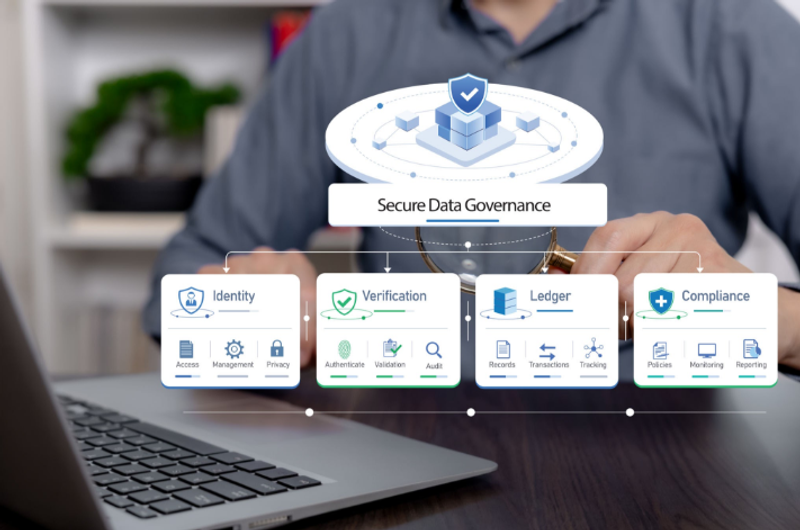
Enterprise Data Governance Architecture. Source: Bussarin Rinchumrus / Getty Images
What is SAP IAG?
SAP Cloud Identity Access Governance (SAP IAG) is a cloud-native software-as-a-service (SaaS) solution built on the SAP Business Technology Platform (BTP). It automates identity lifecycle management, access provisioning, and compliance processes across both SAP and non-SAP environments. By utilizing advanced analytics and pre-configured rulesets, SAP IAG helps organizations detect, prevent, and remediate access risks, ensuring that users have the right access to the right systems at the right time.
How does SAP IAG work?
SAP IAG works by acting as the central intelligence hub for access governance. It connects directly to cloud applications (like SAP SuccessFactors, SAP Ariba, and third-party apps via APIs) and on-premise systems (via the SAP Cloud Connector). It continuously ingests user access data, evaluates it against predefined Segregation of Duties (SoD) and critical access rulesets, and triggers automated workflows for access requests, approvals, and remediation.
Why is SAP IAG important?
SAP IAG is important because manual access governance cannot scale with modern hybrid cloud environments. As organizations adopt more SaaS applications, the risk of over-provisioned users, unauthorized access, and SoD conflicts skyrockets. SAP IAG provides real-time visibility and automated control, shifting access security from a reactive, audit-driven scramble to a continuous, proactive governance state.
What are SAP IAG benefits?
The primary benefits of SAP IAG include rapid deployment (weeks rather than months), automated continuous compliance, reduced audit fatigue, seamless integration with SAP S/4HANA, zero-downtime updates managed by SAP, and a modern, intuitive Fiori-based user experience that accelerates user adoption and approval times.
What industries use SAP IAG?
SAP IAG is heavily utilized by highly regulated industries including Banking & Financial Services, Government & Public Sector, Oil & Gas, Healthcare, and Telecommunications, where strict access controls, audit readiness, and compliance with national cybersecurity frameworks are non-negotiable.
What are SAP IAG implementation challenges?
Common implementation challenges include poor initial role design (migrating bad roles into a new system), lack of clear ownership between IT and Business for approval workflows, and underestimating the effort required to clean up existing SoD conflicts before deploying automated governance.
Why Organizations Need SAP IAG
The transition to SAP S/4HANA and cloud-centric architectures exposes the limitations of spreadsheet-based governance and legacy on-premise tools. For organizations in the GCC—particularly those supporting Saudi Vision 2030 initiatives—national cybersecurity frameworks (like NCA compliance) and internal audit standards require rigorous, documented, and continuous access control.
Governance Maturity Model
Where Does Your Organization Stand?
The following Governance Maturity Model helps executives benchmark their current capabilities against industry standards. Most enterprises in the GCC are struggling at Level 1 or 2.
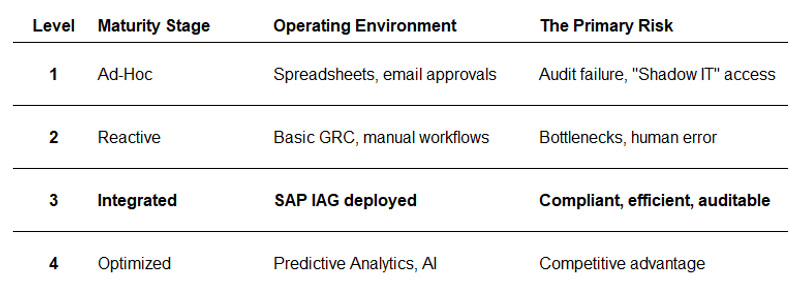
Indicators an Organization May Need SAP IAG
If your organization is experiencing any of the following, professional implementation of SAP IAG should be evaluated:
- Excessive manual user access reviews: IT teams spend weeks compiling spreadsheets for compliance certifications.
- Audit findings related to access controls: Repeated internal or external audit citations for Segregation of Duties (SoD) violations.
- SAP S/4HANA migration projects: Moving to S/4HANA requires redesigning security roles and establishing a clean access baseline.
- Delayed user provisioning: It takes days or weeks for new employees to receive the system access necessary to perform their jobs.
- Fragmented governance: Using disconnected tools for on-premise systems and cloud applications, resulting in a lack of centralized visibility.
Aligning SAP IAG with NCA & SAMA Mandates
In the Kingdom of Saudi Arabia, the regulatory environment is more rigorous than ever. Whether you are subject to the National Cybersecurity Authority (NCA) Essential Cybersecurity Controls (ECC) or the Saudi Central Bank (SAMA) Cyber Security Framework, SAP IAG provides the precise technical controls required for compliance:
- Identity Governance (NCA ECC 2-2024): SAP IAG automates the full "Joiner-Mover-Leaver" lifecycle, ensuring access is provisioned and revoked in lockstep with HR data, satisfying strict access management mandates.
- Privileged Access Management (SAMA CSF): The SAP IAG Firefighter capability provides the audited logging and time-bound access controls that SAMA auditors specifically inspect during periodic examinations.
- Continuous Compliance: Shift from "Point-in-Time" audits (manual spreadsheets) to "Continuous Assessment." SAP IAG’s automated SoD analysis satisfies the regulatory need for constant, systemic vulnerability assessment rather than quarterly manual checks.
Key Features and Capabilities
SAP IAG provides five core microservices that deliver end-to-end governance:
- Access Request Service: Provides a self-service, Fiori-based portal for users to request access. It runs real-time risk simulations before access is granted, allowing managers to make informed approval decisions.
- Access Analysis Service: Continuously scans connected systems to identify SoD conflicts and critical access violations using pre-delivered, SAP-maintained rulesets optimized for S/4HANA and cloud apps.
- Role Design Service: Facilitates the creation, optimization, and lifecycle management of business roles, ensuring they are free of inherent risks before being deployed.
- Access Certification Service: Automates the User Access Review (UAR) process. It generates review campaigns, routes them to the appropriate managers, and automatically de-provisions access if revoked.
- Privileged Access Management (PAM): Manages "Firefighter" or emergency access, requiring justification and approval for temporary elevated privileges, and logging all activities performed during the session.
Competitive Positioning: SAP IAG vs Alternatives
Understanding where SAP IAG fits within the broader Identity Governance and Administration (IGA) landscape is critical for enterprise architects and security teams.
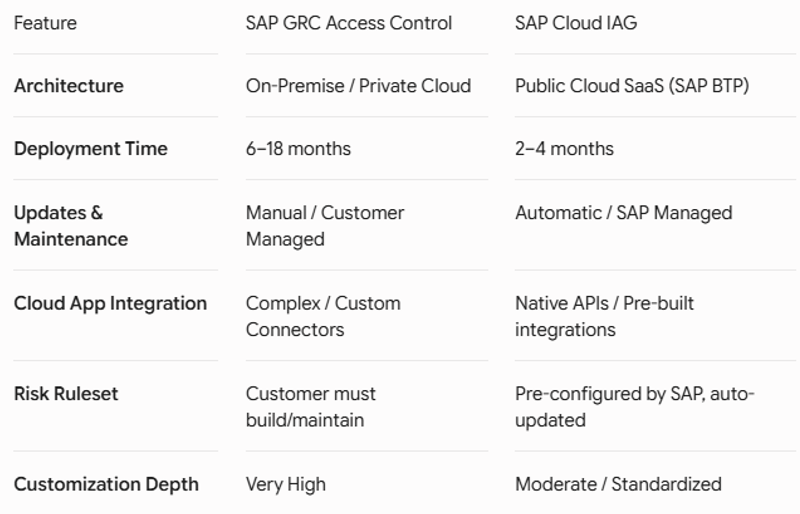
SAP IAG vs SAP GRC Access Control
While both are SAP products, they serve different architectural philosophies. SAP GRC Access Control is a robust, highly customizable on-premise solution. SAP IAG is an agile, cloud-native SaaS solution.
SAP IAG vs SailPoint
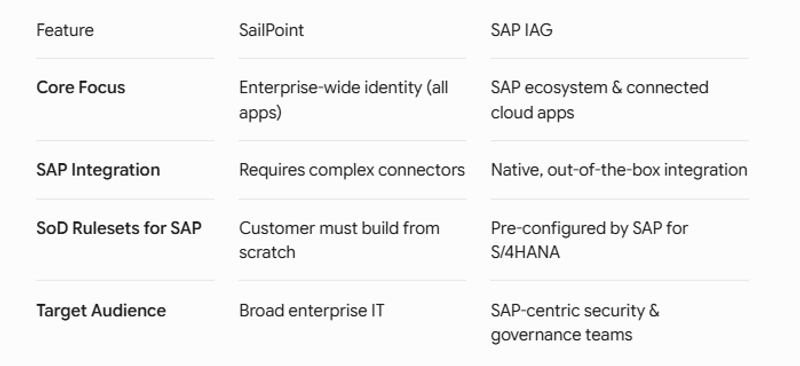
SailPoint is a leader in enterprise-wide IGA, but SAP IAG holds a distinct advantage within SAP-heavy landscapes.
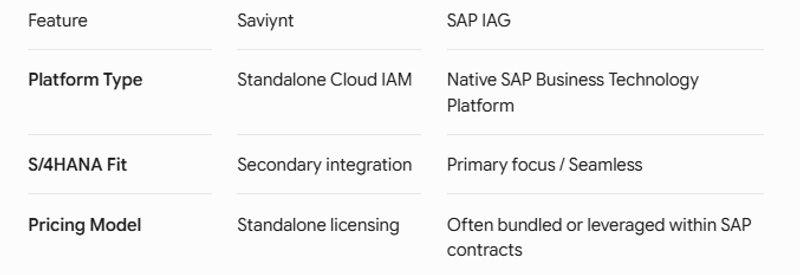
SAP IAG vs Saviynt
Saviynt offers strong cloud IGA capabilities, but SAP IAG's deep alignment with the SAP data model provides a more seamless experience for SAP customers.
Manual Governance vs Automated Governance (SAP IAG)
Industry Use Cases in the GCC
SAP IAG delivers targeted value across key sectors driving the GCC economy and Saudi Vision 2030:
- Banking & Financial Services: Central banks and regulatory bodies (e.g., SAMA) enforce stringent access controls. SAP IAG automates continuous access analysis and certification, preventing financial fraud through rigorous SoD enforcement.
- Government & Public Sector: National digital transformation programs require robust cybersecurity governance. SAP IAG ensures that citizen data is protected by enforcing strict privileged access management (PAM) and compliance reporting.
- Oil & Gas: Managing contractor identities and joint venture access is highly complex. SAP IAG streamlines identity lifecycle management, ensuring that third-party access is provisioned securely and revoked immediately upon contract termination.
- Telecommunications: With massive workforces and high turnover, telecoms struggle with provisioning delays. SAP IAG automates the "Hire-to-Retire" lifecycle, integrating with HR systems to instantly provision and de-provision access based on job roles.
Implementation Considerations & Best Practices
For organizations currently operating on legacy SAP GRC Access Control, the transition to SAP IAG requires a structured architectural shift. We have developed a specific framework to minimize risk during this change.
Deploying SAP IAG is not merely an IT project; it is a business transformation initiative. To ensure a successful implementation and high ROI, Kgenex recommends the following best practices:
- Clean Up Before You Automate: Do not migrate bad data. Conduct a thorough role redesign and remediation exercise to resolve existing SoD conflicts before turning on SAP IAG.
- Standardize Business Roles: Move away from assigning technical transaction codes. Create business roles that align with actual job functions to simplify the access request process for end-users.
- Define Clear Ownership: Establish a governance steering committee. IT should maintain the tool, but Business Process Owners must be accountable for approving access and reviewing risks.
- Leverage the IAG Bridge: For organizations with existing SAP GRC Access Control investments, utilize the "IAG Bridge" scenario. This allows you to maintain complex on-premise governance while using IAG to extend governance to cloud applications like Ariba and SuccessFactors.
Common Mistakes Organizations Make
- Treating IAG as a purely technical upgrade: Failing to engage business stakeholders leads to poorly designed workflows and low adoption.
- Over-customization: Attempting to force SAP IAG to replicate highly customized, complex workflows from legacy systems rather than adopting standard, best-practice processes.
- Ignoring Non-Human Identities: Failing to govern service accounts and RPA bots, which pose significant security risks.
Future Trends
As we look toward the remainder of 2026 and beyond, the access governance landscape is shifting from "Static Compliance" to "Dynamic Intelligence."
- AI-Driven Governance (SAP Joule): The integration of generative AI will allow natural language access requests and provide AI-assisted recommendations during User Access Reviews, significantly reducing reviewer fatigue.
- Context-Aware Access (Zero Trust): Access decisions will increasingly rely on contextual attributes (e.g., location, device health, time of day) rather than just static roles.
- Identity Threat Detection and Response (ITDR): SAP IAG will evolve to not just govern access, but actively monitor for and respond to compromised identities in real-time.
Not sure where you sit on the Governance Maturity Model? You don't need to navigate the complexities of S/4HANA security alone. At Kgenex, we help organizations transition from reactive manual controls to automated, audit-ready governance. Click here to schedule a 15-minute Governance Readiness Assessment with our lead consultant We don't just implement software; we audit your specific compliance risks and build a roadmap tailored to Saudi regulatory standards.
Conclusion
SAP Cloud Identity Access Governance (IAG) represents the future of compliance and security for SAP-centric organizations. By automating risk analysis, streamlining provisioning, and providing continuous compliance visibility, SAP IAG enables enterprises to reduce audit costs, accelerate digital transformation, and confidently secure their hybrid landscapes.
For organizations in Saudi Arabia and the GCC navigating complex regulatory environments and ambitious modernization programs, adopting SAP IAG is a strategic imperative. Partnering with a specialized implementation expert ensures that the technology is aligned with business processes, maximizing ROI and minimizing risk.
SAP GRC to SAP IAG Migration Roadmap
SAP IAG Governance Readiness Assessment: A Guide for GCC Enterprises
SAP IAG Implementation Roadmap: A Strategic Guide for GCC Enterprises
SAP IAG ROI & Business Case: A Strategic Guide for GCC Enterprises
SAP Official Documentation:
SAP Help Portal for Cloud Identity Access Governance.
Gartner/Forrester:
Industry reports on Identity Governance and Administration (IGA) trends.
National Cybersecurity Authority (NCA):
Saudi Arabia’s official guidelines on access control requirements.
Frequently Asked Questions
How much does SAP IAG cost?
Pricing is subscription-based (SaaS), typically determined by the number of managed users and the specific microservices activated. It generally presents a lower total cost of ownership compared to maintaining on-premise infrastructure.
How long does SAP IAG implementation take?
A standard implementation takes between 2 to 4 months, significantly faster than the 6 to 18 months typically required for on-premise SAP GRC deployments.
Is SAP IAG suitable for SAP S/4HANA?
Yes, SAP IAG is the recommended access governance solution for SAP S/4HANA (both Cloud and On-Premise), featuring pre-configured rulesets specifically designed for the S/4HANA data model.
Can SAP IAG replace SAP GRC?
For organizations moving entirely to the cloud, IAG can serve as a replacement. For highly complex on-premise landscapes, they often co-exist using the IAG Bridge scenario.
What are the prerequisites for SAP IAG?
Organizations need an active SAP BTP tenant and an SAP Identity Authentication Service (IAS) tenant to manage user authentication.
How does SAP IAG compare to SailPoint?
SailPoint focuses on broad enterprise application coverage, while SAP IAG provides deeper, out-of-the-box integration and pre-built risk rulesets specifically for the SAP ecosystem.
SAP IAG vs Saviynt: Which is better?
Saviynt is a strong standalone cloud IGA, but SAP IAG is superior for organizations heavily invested in SAP, as it natively understands SAP's complex security model.
How does SAP IAG integrate with Microsoft Entra ID?
SAP IAG integrates seamlessly with Microsoft Entra ID (formerly Azure AD), using Entra ID for overarching identity management and SSO, while IAG handles granular, application-level SoD and risk analysis.
What are the SAP IAG deployment models?
SAP IAG is strictly a Public Cloud SaaS offering hosted on the SAP Business Technology Platform (BTP).
What are the SAP IAG integration options?
It natively integrates with SAP cloud solutions (SuccessFactors, Ariba, Fieldglass), SAP on-premise systems via Cloud Connector, and third-party applications via SCIM APIs.
How to select an SAP IAG implementation partner?
Look for partners with deep expertise in both SAP Security and Business Technology Platform (BTP), proven experience with S/4HANA migrations, and a strong understanding of regional compliance mandates (like Saudi NCA).
What are common SAP IAG implementation risks?
Migrating existing SoD conflicts without remediation, lack of business user training, and poorly defined approval workflows.
What skills are required to manage SAP IAG?
Administrators need knowledge of SAP Security concepts (roles, authorizations), basic understanding of SAP BTP, and familiarity with cloud identity standards (SAML, SCIM).
What is the expected ROI of SAP IAG?
ROI is achieved through drastically reduced audit preparation time, automation of manual provisioning tasks, and prevention of financial fraud via strict SoD enforcement.
Does SAP IAG support non-SAP applications?
Yes, it can integrate with non-SAP cloud applications using standard SCIM (System for Cross-domain Identity Management) APIs.
How does SAP IAG handle Segregation of Duties (SoD)?
It uses SAP-maintained rulesets to analyze user access across multiple systems simultaneously, flagging conflicts before access is provisioned.
Can SAP IAG automate user access reviews (UAR)?
Yes, the Access Certification microservice fully automates the creation, routing, and execution of periodic user access reviews.
How does SAP IAG support Saudi Vision 2030 compliance?
It enforces the strict identity controls, access logging, and separation of duties required by the National Cybersecurity Authority (NCA) frameworks.
What is the IAG Bridge scenario?
It is a deployment architecture where an existing on-premise SAP GRC Access Control system connects to SAP IAG to extend risk analysis and governance to cloud applications.
Does SAP IAG offer Emergency Access Management (Firefighter)?
Yes, the Privileged Access Management (PAM) module handles emergency access requests, logging, and review workflows for cloud and connected systems.
Ready to modernize your enterprise access governance?
Manual compliance processes are no longer sustainable in a cloud-first world. At Kgenex, our experts specialize in securing complex SAP landscapes and ensuring compliance with regional mandates across Saudi Arabia and the GCC. Contact our advisory team today to schedule an SAP IAG readiness assessment and discover how automated governance can accelerate your digital transformation.
Let's Go!Kgenex Editorial Team
Riyadh, Saudi Arabia