SAP IAG ROI & Business Case: A Strategic Guide for GCC Enterprises
Ready to translate governance into growth?
Do not allow identity management to be an operational drag on your digital transformation. Schedule a Business Case Alignment Workshop with our consulting team to map your current risk landscape against SAP IAG capabilities and receive a customized TCO assessment tailored to your organization. This guide is prepared for strategic decision-making. All financial projections are based on standard industry benchmarks and should be adjusted to your specific organizational scale. Given your current landscape, are you primarily looking to address an immediate audit/compliance finding, or are you in the early planning stages of a broader SAP S/4HANA cloud transformation?
Schedule a Business Case Alignment WorkshopIn the context of the GCC’s rapid digital transformation and Vision 2030, manual identity and access management (IAM) processes represent a significant "hidden" cost and a substantial security liability. SAP Identity Access Governance (IAG) is not merely a technical implementation; it is a strategic business enabler that bridges the gap between operational agility and regulatory compliance. This guide provides a blueprint for executives to quantify the value of SAP IAG, focusing on three core pillars: Risk Mitigation: Aligning with NCA (Saudi National Cybersecurity Authority) and SAMA (Saudi Central Bank) mandates. Operational Efficiency: Automating user provisioning and lifecycle management. Audit Readiness: Reducing the cost and duration of internal/external audits. Investment Thesis: Transitioning to SAP IAG yields a projected ROI of 150%–250% over three years through the elimination of manual GRC labor, avoidance of regulatory fines, and reduction in audit cycle times.
In the context of the GCC’s rapid digital transformation and Vision 2030, manual identity and access management (IAM) processes represent a significant "hidden" cost and a substantial security liability. SAP Identity Access Governance (IAG) is not merely a technical implementation; it is a strategic business enabler that bridges the gap between operational agility and regulatory compliance.
This guide provides a blueprint for executives to quantify the value of SAP IAG, focusing on three core pillars:
- Risk Mitigation: Aligning with NCA (Saudi National Cybersecurity Authority) and SAMA (Saudi Central Bank) mandates.
- Operational Efficiency: Automating user provisioning and lifecycle management.
- Audit Readiness: Reducing the cost and duration of internal/external audits.
Investment Thesis: Transitioning to SAP IAG yields a projected ROI of 150%–250% over three years through the elimination of manual GRC labor, avoidance of regulatory fines, and reduction in audit cycle times.
Business Case Overview
Organizations often treat GRC (Governance, Risk, and Compliance) as an "insurance policy"—a sunk cost. The business case for SAP IAG flips this narrative by positioning it as a productivity multiplier.
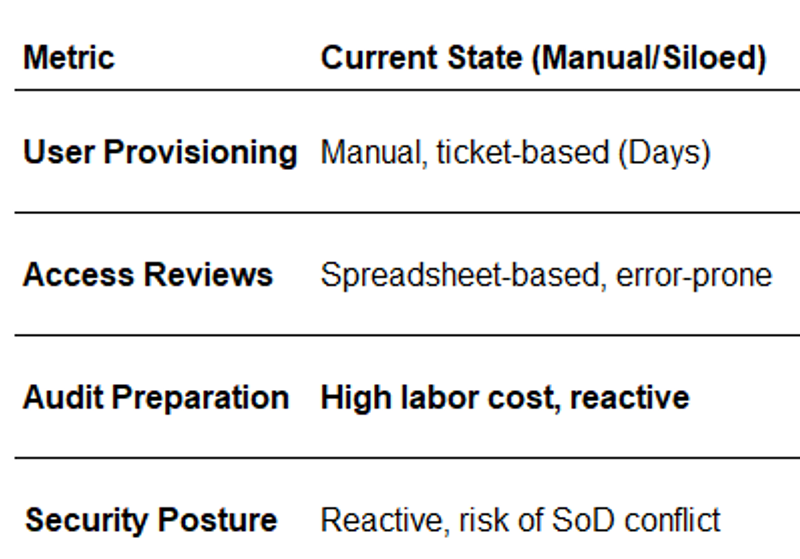
The "Before vs. After" Snapshot
Cost Analysis (Total Cost of Ownership)
To build a credible case, you must account for all cost levers:
- Direct Costs: SAP IAG subscription/license fees, implementation partner services, and internal project management resources.
- Indirect Costs: Change management (crucial for adoption), user training, and integration maintenance with legacy systems.
- Hidden Costs: Data cleansing (the effort to standardize roles before migration) and the cost of parallel running (if transitioning from legacy GRC).
Benefit Analysis
1. Hard Savings (Quantifiable)
- Reduction in IT Support Costs: Automating the user lifecycle (Joiner-Mover-Leaver) reduces Tier 1 and Tier 2 IT support tickets by up to 60%.
- Audit Efficiency: Streamlining the evidence-gathering process reduces audit-related labor costs by 30–40%.
- System Downtime/Breach Avoidance: Quantifying the "Cost of a Breach" using industry-standard benchmarks for the Saudi financial/energy sector.
2. Soft Savings (Qualitative)
- Compliance Alignment: Demonstrating proactive adherence to NCA Essential Cybersecurity Controls (ECC) and SAMA Cyber Security Framework.
- Operational Resilience: Eliminating manual errors that lead to access creep and potential fraud.
- User Experience: Faster access provisioning leads to higher employee productivity from "Day 1."
ROI Calculation Framework
We recommend using a 3-year Total Value of Ownership (TVO) model.
Formula:

Sample ROI Calculation (Hypothetical: Large KSA Enterprise)
Assume 5,000 SAP users.
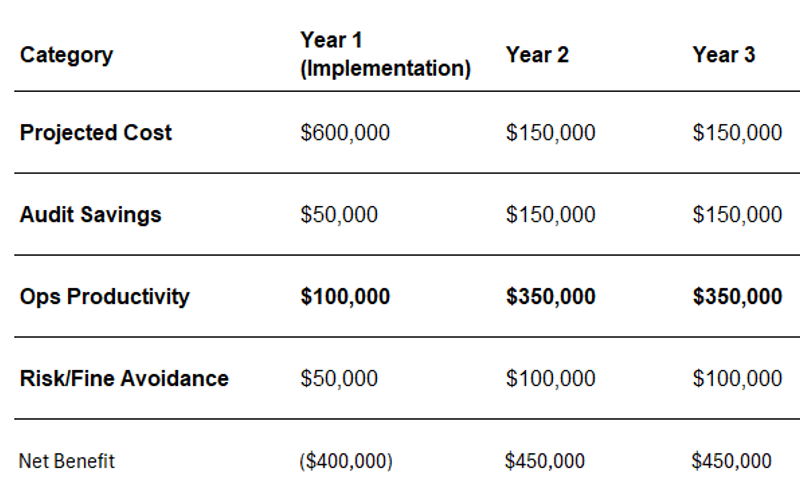
Payback Period: ~20 months.
3-Year ROI: ~125% (Conservative estimate).
Industry-Specific Scenarios
1. Oil & Gas (Saudi Aramco/Petrochemical context)
- Driver: Critical Infrastructure Protection.
- Focus: Managing high-turnover contractor access. SAP IAG automates the lifecycle of thousands of temporary accounts, ensuring they are revoked immediately upon contract end, preventing unauthorized entry.
2. Banking & Finance (SAMA-regulated)
- Driver: Strict Data Governance and Fraud Prevention.
- Focus: Segregation of Duties (SoD). Automated alerts prevent employees from having conflicting access rights (e.g., ability to create a vendor AND approve a payment).
3. Government & Public Sector
- Driver: Transparency and Accountability.
- Focus: Audit readiness. The automated reporting capabilities provide "push-button" evidence for compliance audits, reducing the strain on civil servants during reporting periods.
Risks & Assumptions
- Assumption: Data quality within the current SAP environment is stable. (If data is messy, implementation costs will increase).
- Risk: Cultural resistance. Automated governance often feels restrictive to users accustomed to "unfettered access."
- Mitigation: Executive sponsorship is mandatory. If the C-Suite does not mandate the governance policy, the tool will be bypassed.
Recommendations
- Start Small: Run a Pilot (PoC) focusing on the most critical high-risk processes (e.g., Procure-to-Pay).
- Focus on Data Hygiene: Before deploying SAP IAG, clean your existing roles and authorizations.
- Align with Regulatory Timelines: Schedule the implementation to precede the annual NCA/SAMA audit cycle to maximize the visibility of benefits.
SAP Cloud IAG vs SAP GRC: Which Access Governance Solution Do You Need?
SAP GRC to SAP IAG Migration Roadmap
SAP IAG Governance Readiness Assessment: A Guide for GCC Enterprises
SAP IAG Implementation Roadmap: A Strategic Guide for GCC Enterprises
SAP Official Documentation:
SAP Help Portal for Cloud Identity Access Governance.
Gartner/Forrester:
Industry reports on Identity Governance and Administration (IGA) trends.
National Cybersecurity Authority (NCA):
Saudi Arabia’s official guidelines on access control requirements.
Frequently Asked Questions
Q: Can we keep our legacy GRC on-premise?
A: You can, but you will miss out on the cloud-native agility, AI-powered access analysis, and lower TCO of SAP IAG.
Q: Is SAP IAG just for SAP systems?
A: No, it integrates with non-SAP systems, providing a unified governance layer across your entire enterprise architecture.
Q: How do we measure "Compliance Savings"?
A: By calculating the (Number of Audit Findings) x (Average Cost to Remediate per Finding) + (Cost of Audit Team Hours).
Ready to translate governance into growth?
Do not allow identity management to be an operational drag on your digital transformation. Schedule a Business Case Alignment Workshop with our consulting team to map your current risk landscape against SAP IAG capabilities and receive a customized TCO assessment tailored to your organization. This guide is prepared for strategic decision-making. All financial projections are based on standard industry benchmarks and should be adjusted to your specific organizational scale. Given your current landscape, are you primarily looking to address an immediate audit/compliance finding, or are you in the early planning stages of a broader SAP S/4HANA cloud transformation?
Schedule a Business Case Alignment WorkshopKgenex Editorial Team
Riyadh, Saudi Arabia