SAP IAG Implementation Roadmap: A Strategic Guide for GCC Enterprises
Is your identity governance posture ready for the future?
The complexity of S/4HANA security requires a modern approach. Do not let compliance hurdles stall your digital transformation. Let's review your current landscape and build your custom transformation roadmap. What is the current status of your SAP landscape, and are you currently facing specific audit challenges regarding user access and Segregation of Duties?
Book a Strategy Session with our SAP IAG ExpertsIn the rapidly evolving digital landscape of Saudi Arabia and the GCC, transitioning to a cloud-native identity strategy is no longer optional—it is a business imperative. SAP Identity Access Governance (IAG) is the cornerstone of this transition, enabling organizations to unify access control across hybrid landscapes (on-premise S/4HANA and Cloud). This roadmap provides a battle-tested framework for implementing SAP IAG. Whether you are migrating from legacy SAP GRC or starting your identity journey, this guide focuses on minimizing business disruption, ensuring regulatory compliance (NCA, SAMA, NDMO), and maximizing the ROI of your SAP investments.
1. Implementation Overview
SAP IAG is a "cloud-first" service on SAP Business Technology Platform (BTP). Our implementation philosophy follows a Modular, Risk-Based Approach:
- Phase 1: Foundation & Connectivity (Technical Readiness)
- Phase 2: Process Alignment & Design (Governance)
- Phase 3: Execution & Integration (Technical Implementation)
- Phase 4: Validation & Adoption (Cutover)
2. Prerequisites Assessment
Before kicking off, ensure the following checklist is completed to avoid "scope creep":
- BTP Readiness: Active SAP BTP Subaccount with IAG services enabled.
- Connectivity: SAP Cloud Connector installed and configured for hybrid landscapes.
- Data Quality: A cleansed User Master Data (CUA or IDM) source.
- Stakeholder Buy-in: CISOs and Audit leads must agree on "Global Risk Definitions" before technical configuration begins.
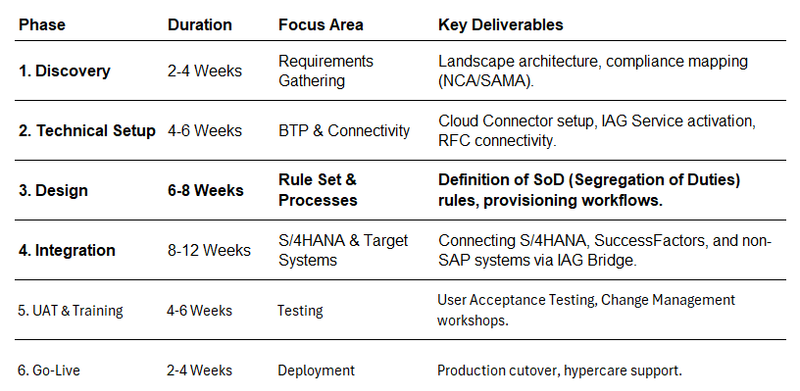
3. Detailed Implementation Roadmap
4. Project Governance Model (GCC-Specific)
Given the stringent regulatory environment in the GCC (e.g., NCA – National Cybersecurity Authority and SAMA – Saudi Central Bank guidelines), governance is paramount.
- Compliance Steering Committee: Must include the CISO, Head of Internal Audit, and SAP Program Manager.
- Data Residency: Ensure the SAP BTP data center region is selected to align with local data sovereignty laws (e.g., using SAP data centers in the region where available).
- Regular Audit Trails: IAG configuration must be logged for annual NCA/SAMA external audits.
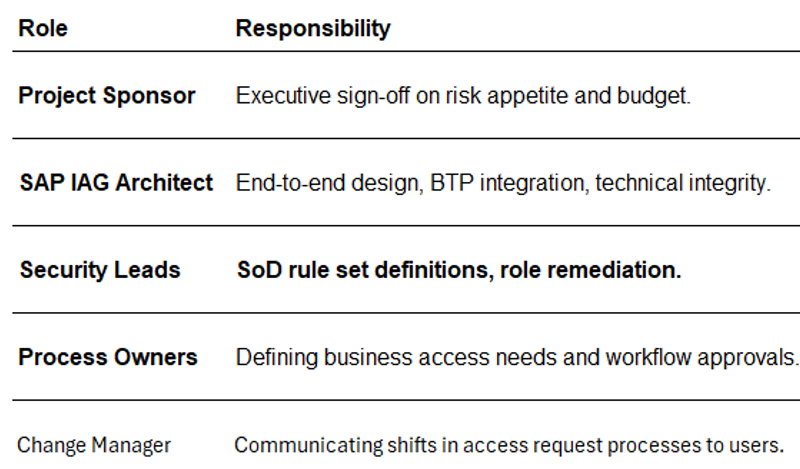
5. Roles & Responsibilities Matrix
6. Risks & Dependencies
- Risk: Poor Data Quality: Inaccurate user data prevents automated provisioning. Mitigation: Perform a data cleansing sprint prior to Phase 2.
- Risk: Custom Transaction Codes: Non-standard T-Codes are often ignored in standard rule sets. Mitigation: Conduct a custom code analysis before designing the rule set.
- Dependency: The implementation is heavily dependent on the SAP Cloud Connector stability. If the network team is not involved early, project delays are inevitable.
7. Implementation Best Practices
- Start with "Access Analysis": Do not attempt to fix all provisioning issues immediately. Focus first on visibility (IAG Access Analysis Service) to understand existing risk exposure.
- Adopt Standard Content: Leverage SAP’s predefined business rules for S/4HANA before building custom rules.
- Automate Lifecycle Management: Focus on the "Joiner-Mover-Leaver" process. This provides the highest ROI for security teams.
8. Common Mistakes to Avoid
- "Lift and Shift": Trying to replicate your old, broken GRC processes in IAG. Better approach: Re-engineer the process during migration.
- Ignoring Non-SAP Systems: IAG has robust connectors for non-SAP systems. Failing to integrate these leads to "siloed security" and audit findings.
- Underestimating Training: Users find new workflows confusing. Invest in "just-in-time" training videos.
9. Recommendations for Success
- Hybrid Strategy: Utilize the IAG Bridge to manage both cloud and on-premise systems. Do not build separate processes for each.
- Phased Deployment: Deploy IAG for a single, high-risk business unit first (e.g., Finance) before a global rollout.
- Continuous Compliance: Move from annual "firefighting" audits to "Continuous Compliance" monitoring using IAG dashboards.
SAP Cloud IAG vs SAP GRC: Which Access Governance Solution Do You Need?
SAP GRC to SAP IAG Migration Roadmap
SAP IAG Governance Readiness Assessment: A Guide for GCC Enterprises
SAP IAG ROI & Business Case: A Strategic Guide for GCC Enterprises
SAP Official Documentation:
SAP Help Portal for Cloud Identity Access Governance.
Gartner/Forrester:
Industry reports on Identity Governance and Administration (IGA) trends.
National Cybersecurity Authority (NCA):
Saudi Arabia’s official guidelines on access control requirements.
Frequently Asked Questions
Does SAP IAG replace SAP GRC?
It is an evolution. While they serve similar goals, IAG is the cloud-native, BTP-based solution designed for hybrid landscapes, whereas GRC 12.0 is primarily on-premise
Can we keep our existing GRC 12.0 implementation?
Yes, co-existence is possible using the IAG Bridge. We can help you map out a hybrid coexistence strategy.
How does this help with NCA compliance?
IAG provides automated logs, access certification, and SoD analysis—all critical requirements for NCA compliance controls regarding identity management and access control.
Is your identity governance posture ready for the future?
The complexity of S/4HANA security requires a modern approach. Do not let compliance hurdles stall your digital transformation. Let's review your current landscape and build your custom transformation roadmap. What is the current status of your SAP landscape, and are you currently facing specific audit challenges regarding user access and Segregation of Duties?
Book a Strategy Session with our SAP IAG ExpertsKgenex Editorial Team
Riyadh, Saudi Arabia